
- Home
- Services Details
Professional Grout Restoration Renews Worn, Stained, and Uneven Grout Lines
Grout can stay dark, blotchy, or tired even after repeated cleaning because the problem often sits inside the joint rather than on the surface. Raiden Restoration provides grout restoration services to restore grout by identifying what changed, correcting the condition, and rebuilding the protection the joint needs to stay easier to maintain.
How Raiden Restoration Restores Grout Beyond Surface Cleaning?
Grout is porous, especially traditional cementitious grout. Once its original protection weakens, moisture, soap residue, cooking oils, tracked soil, and cleaning solution can move below the surface. That is why tile and grout cleaning sometimes improves the floor while leaving the joints uneven. The tile releases soil more easily, but the grout continues holding contamination in its pores.
Professional restoration looks at the condition of the joint first. If the grout is structurally sound, it may be cleaned, corrected, recolored where appropriate, and protected. If sections are cracked, missing, loose, or contaminated beyond a stable result, those areas need a different treatment before appearance becomes the priority.
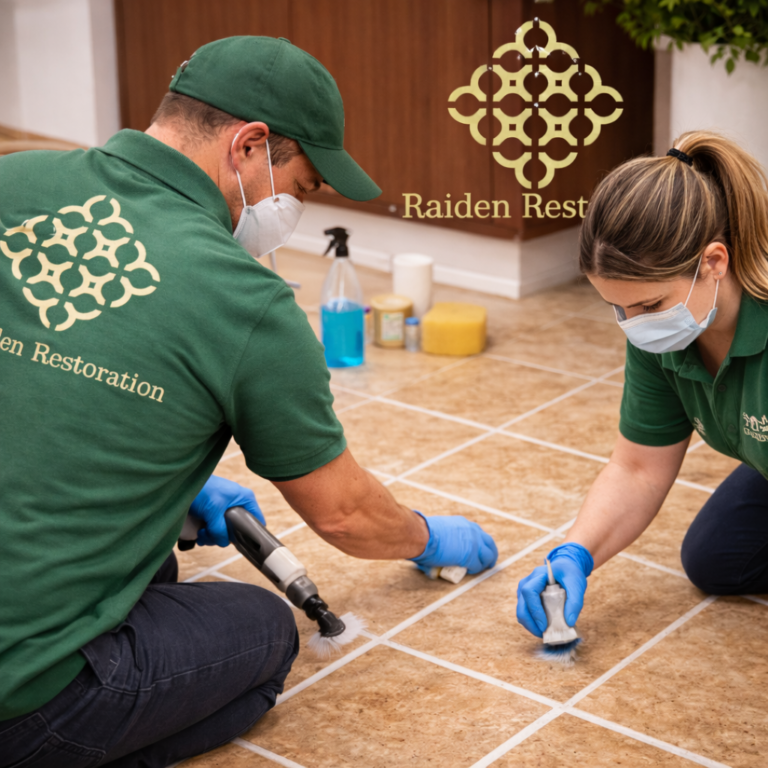
What Is Professional Grout Restoration and What Does It Actually Fix?
Grout restoration is the process of returning existing grout joints to a cleaner, more uniform, stable, and protected condition without automatically removing the surrounding tile. It may involve deep soil removal, residue correction, localized repair, color correction, and renewed protection depending on the grout type and damage present. Restoration addresses conditions that remain after ordinary cleaning, including deep discoloration, inconsistent color, sealer failure, porous joints, surface wear, and small areas of deterioration.
The method also changes with the material. Cementitious grout absorbs moisture and contaminants more readily than epoxy grout, while older joints may already contain previous sealers or colorants. Before choosing chemistry or equipment, I need to know what is actually in the joint. That assessment keeps tile and grout cleaning services from becoming a one-size-fits-all treatment for every floor or shower.
Which Grout Problems Can Be Restored Without Replacing the Tile?
Deep Grout Cleaning
When grout has absorbed body oils, soap residue, cooking film, or tracked soil, surface scrubbing rarely reaches the contamination. I use appropriate professional cleaning solutions and controlled agitation to release buildup from porous joints, then remove the suspended soil completely. This creates a clean foundation for any later corrective treatment.
Grout Color Correction
Some grout remains blotchy after cleaning because staining has penetrated unevenly or previous products changed the joint color. In those cases, color correction can create a more consistent appearance without replacing sound tile. The goal is not to hide damage, but to renew stable grout that has become visually inconsistent.
Grout Repair and Cleaning
Grout repair and cleaning belong together when isolated joints have deteriorated. Loose material must be addressed before appearance work can hold up. I evaluate whether the damaged section is suitable for repair, remove unstable material where appropriate, and restore the joint so surrounding grout can be cleaned and finished consistently.
Floor Tile and Grout Cleaning
Floor tile and grout cleaning is the preparation stage for restoring used grout. Residue, soil, and old maintenance products must be removed before protection is renewed. A clean joint accepts the next treatment more predictably, which helps prevent trapped contamination, uneven appearance, and premature failure after the restoration is complete.
How I Restore Grout Without Treating Every Surface the Same
Assessing Grout Type and Condition
The first step is determining whether the joint is cementitious grout, epoxy grout, repaired grout, or a previously colored surface. I carefully inspect discoloration, cracking, absorption, residue, and sealer behavior. This tells me whether the problem is removable contamination, permanent staining, failed protection, physical deterioration, or several conditions happening together.
Removing Embedded Contamination
Restoration begins with the soil that can be safely removed. I select chemistry according to the surface, allow dwell time, agitate the joints, and extract released residue instead of spreading it around. Any remaining discoloration can then be judged accurately because the grout is no longer masked by removable buildup.
Repairing and Correcting Grout
Once the grout is clean, I deal with issues that cleaning cannot solve. That can include localized repair, residue correction, or color adjustment on sound joints. I avoid covering unstable grout with a cosmetic treatment because loose, cracked, or failing material needs correction before a durable finished appearance is possible.
Protecting and Inspecting the Finish
The final treatment depends on the grout, its condition, and how the surface is used. After application, I check joint consistency, residue removal, edge cleanliness, and overall appearance under normal lighting. I also carefully explain the initial cure or dry period and the maintenance products that should be avoided afterward.
What I Check Before I Consider Grout Restoration Complete
My standard is not whether the grout looks better while it is still wet. Wet grout naturally appears darker and can hide unevenness. I evaluate the finished joints for consistent appearance, remaining residue, repair stability, and obvious areas that still react differently from the surrounding grout.
I am David Madsen, founder of Raiden Restoration, and I would rather explain a limitation than sell a treatment that cannot solve the underlying problem. If movement, recurring moisture, failed installation, or severe joint loss makes restoration a poor choice, I will tell you where the boundary is. That honest scope is part of the service.
After the work, I also give practical care guidance because restored grout can be damaged by the wrong maintenance routine. Grout cleaning services should not end with a better-looking surface and no explanation of how to keep it that way. The products used afterward matter to the life of the result.
If Your Grout Still Looks Dirty After Cleaning
If you have been searching for grout restoration near me because scrubbing no longer changes the appearance, the next step is to determine whether the joints need deeper cleaning, repair, color correction, renewed protection, or a combination. Tell me what you are seeing, and I will help you understand which level of restoration makes sense.
Call Us 24/7
206-458-9942
- Faqs
Got Questions? We’ve Got Answers
What Is the Best Thing for Cleaning Grout?
The best thing for cleaning grout depends on the grout type and contamination. A pH-appropriate cleaner, controlled agitation, thorough rinsing, and complete soil removal protect the joint.
How Long Does Grout Take to Dry After Cleaning?
Grout may feel dry within hours, but deeper moisture can remain longer. Drying time depends on porosity, ventilation, temperature, joint depth, and whether sealing follows cleaning.
Can Grout be Restored Instead of Replaced?
Sound grout can often be restored through deep cleaning, localized repair, color correction, or renewed protection. Loose, extensively cracked, or moisture-damaged joints may require removal instead.
How To Reseal Grout After Cleaning?
To reseal grout after cleaning, remove all contamination, rinse thoroughly, allow the joints to dry completely, then apply a compatible sealer evenly and remove surface residue.
What’s the Best Way To Clean and Maintain Grout After Sealing?
Maintain sealed grout with a compatible neutral cleaner, prompt spill removal, soft agitation, and regular rinsing. Avoid harsh acids or aggressive products that can shorten sealer performance.
Contact with us for any advice
Need help? Talk to an expert
- 206-458-9942
- davidmadsen91@gmail.com
- 4105 Shelby Road, Lynnwood, WA 98087